Playing on a private server with friends
A private server is your world: your rules, your friends, progress kept between sessions. Here's how to launch one — and above all how to answer the three questions your group will ask within the hour.
Why a server, rather than just inviting people in
That's the starting question, and it has a real answer.
When you open your single-player game to friends, your machine is the host. Three immediate consequences:
- you have to be online for the others to play — if they want to make progress on a Thursday evening when you're out, they can't;
- your PC computes the world and your game at once, on the same processor;
- you leave, everyone drops. In the middle of a dungeon, that gets noticed.
A dedicated server moves the hosting elsewhere. The world exists independently of who's online, and anyone in the group can play whenever. That's the only difference, but it changes everything for a group whose schedules don't line up.
The address, and why it doesn't change
As soon as the server runs, a stable address appears in your console. It doesn't change between sessions, even after a full shutdown: you hand it out once and your group keeps it forever.
It's a small detail that isn't one. A server whose address changes on every start forces you to re-broadcast it each session — and someone always ends up on the old one.
One exception worth knowing: on Valheim in crossplay, console players join with a join code, and that one does change on every start. The address stays stable for Steam players. See the Valheim crossplay guide.
The password, game by game
Not every game guards its front door the same way, and that's the second question that lands:
- Valheim requires a password (five characters minimum, and it must not be contained in the server's name). Generated automatically.
- Palworld has two distinct passwords: the players' one, and the admin one that grants in-game powers. Never merge them — otherwise your whole group is an administrator.
- Factorio uses a game password, and the server isn't publicly listed.
- Minecraft has no password: the door is held with the whitelist (add your group's usernames) and operators.
- Project Zomboid uses a server password.
All of it is shown in your console, next to the address.
Giving console access without giving up your seat
Sharing the address is enough to play. But if you'd rather not be the only one who can start the server — because that makes you the group's bottleneck — you can invite by link, with two roles:
- operator: start, stop, manage the world. For people you trust who play when you aren't around.
- member: see the address and join, without changing anything.
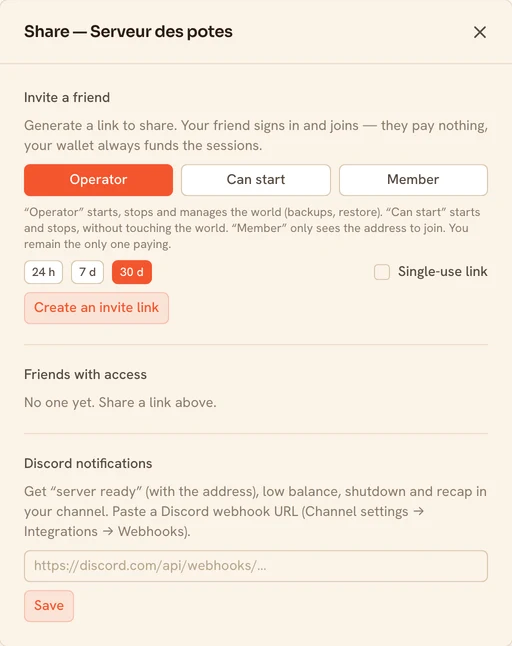
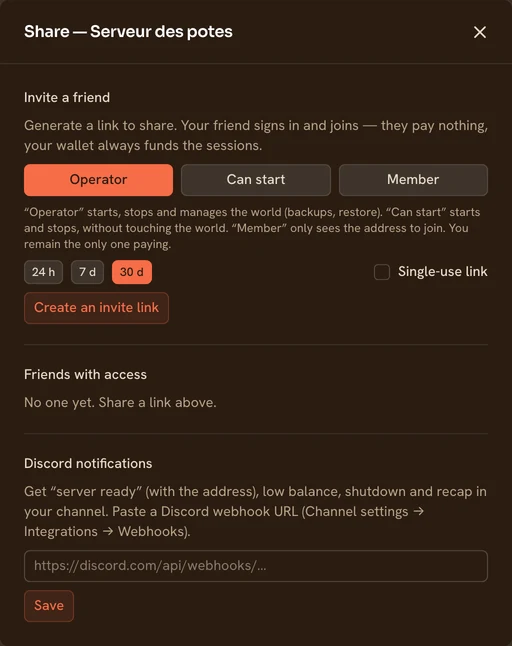
That's the difference between a "group server" and "the server belonging to whoever made it".
Keeping the group informed without thinking about it
A Discord webhook wired to the server posts in your channel when it starts, stops, or when someone connects. Nobody has to ask "is it up?" any more — the answer is already in the thread.
A Discord bot also lets you wake it from the channel, without going through the console.
Splitting the bill
That's the third question, and usually the most awkward to ask: who pays?
With shared wallets, everyone puts in what they want and the servers draw on that pot first, before the creator's own balance. Nobody fronts money for the others, nobody keeps score.
At a realistic rhythm — three evenings of three hours a week on an 8 GB server — the monthly bill is €1.08. Split four ways, that's twenty-seven cents each. The sharing question is mostly a formality.
Play, then shut it down
You only pay for the hours played. Once nobody is connected, the server stops on its own — and you're never cut off mid-game while a player is still there.
The world is saved before every shutdown and restored on the next session, with an automatic backup every 30 minutes while you play, of which the last 5 are kept. Storage is free, server off included.
In practice, for a group: you play Tuesday and Thursday, the server sleeps the rest of the week, and costs nothing meanwhile. It's the only model where a group server doesn't need to earn its keep.
Create your server and start your first game with friends.